
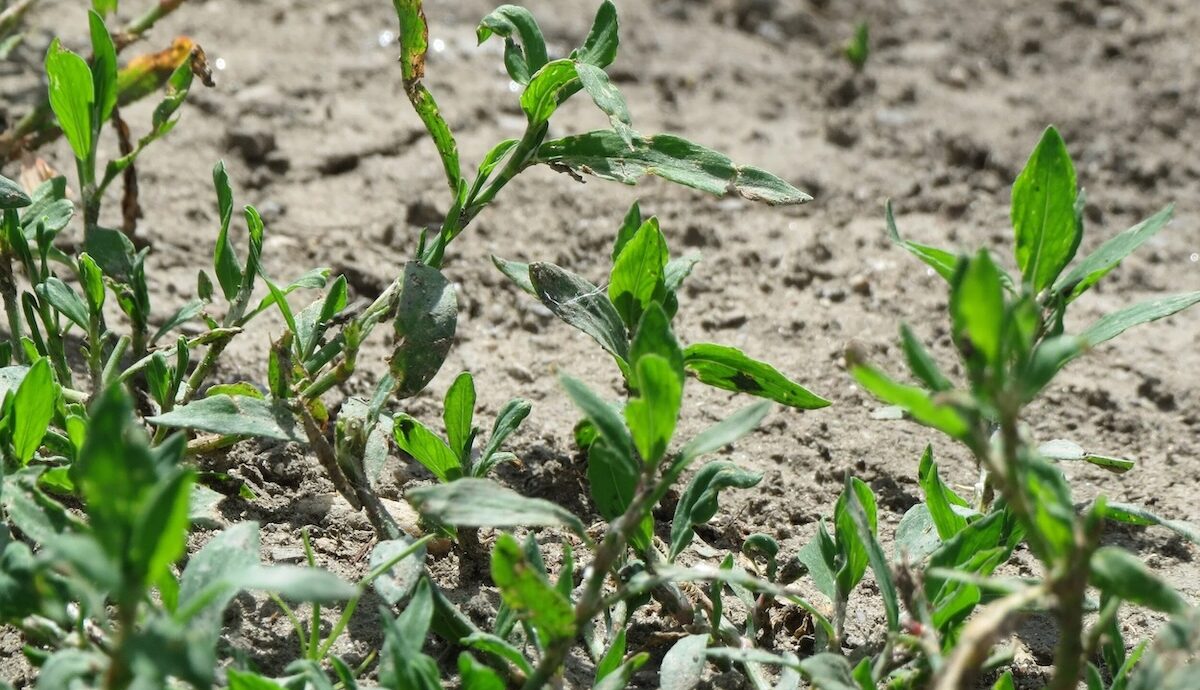
At first glance, the low-growing grass spreading along your dam’s edge can look like ordinary couch or kikuyu. Common knotgrass has that same mat-forming habit. But it’s an exotic species that spreads by seed and via runners both above and below ground, and it’s classified as a major agricultural weed across several Australian states.
Left unchecked, it moves quickly and makes a genuine mess of water access and water quality.
Here’s what you’re dealing with.
What Is Common Knotgrass?
Common knotgrass, or Paspalum distichum, is a fast-growing perennial grass reaching up to 60 centimetres tall. Its most reliable identification feature is the flower head: two branches spreading from a single stalk in a Y shape, green to purplish-brown, appearing between February and May. Those paired branches are what distinguish it from the ordinary couch and paspalum species that grow in lawns and along roadsides near water.
Common knotgrass is an exotic species that’s spread well beyond its native range across Australia. Paspalum distichum reproduces by seed and spreads vegetatively: rhizomes push underground while stolons creep along the soil surface. That dual dispersal mechanism means a single plant can expand in multiple directions at once, and each severed stolon node landing on damp soil becomes a new plant.
It turns up across NSW, QLD, SA, TAS, VIC, and WA.
Is Common Knotgrass the Same as Water Couch?
Yes. Water couch is the most widely used alternative name for Paspalum distichum, and it’s how knotgrass weed often appears on product labels and in state weed management documentation. You might also see it called Water Finger-Grass, Couch Paspalum, Thompson Grass, or Eternity Grass. All are the same plant.
The ‘couch’ in water couch reflects its mat-forming, stolon-spreading growth habit, which looks similar to common lawn couch. The two plants behave very differently, though: water couch thrives in wet margins and shallow waterways, not dry lawn conditions.
Where Does Common Knotgrass Grow?
Common knotgrass grows at watercourse edges, along dam banks, and on any damp margin that isn’t consistently submerged. Unlike fully aquatic weeds, it establishes in the wet/dry boundary zone where water levels fluctuate seasonally. That’s the same zone where stock water access points sit and irrigation intakes are positioned, right where dam owners carry out most of their routine work.
The weed thrives in nutrient-rich, disturbed soil. Banks disturbed by stock trampling or vehicle access are particularly susceptible: cleared ground with excess nutrients from animal waste gives knotgrass ideal establishment conditions, from which it spreads laterally via stolons and underground rhizomes.
Paspalum distichum’s distribution across six states reflects how well it adapts to Australian conditions. The worst infestations tend to crop up in slower, lower-gradient waterways with nutrient-enriched banks.
Why Is Common Knotgrass a Problem?
Beyond the dam, knotgrass has a significant history as a crop weed, particularly in rice farming and irrigated systems across NSW and QLD. That record reflects its capacity to establish quickly in any wet, nutrient-rich environment where bare ground is available.
Along the dam margin, a dense stand creates several compounding problems:
- It outcompetes any remaining native vegetation along the bank, removing the plants that stabilise soil and support habitat for birds and insects.
- Dense growth restricts stock water access along the dam’s edge and into the shallows, particularly as stands extend further into the water.
- As the biomass builds up seasonally and decomposes, dissolved oxygen in the water drops, placing fish and aquatic life under stress.
- Established stands block irrigation intakes and fittings positioned around the waterway margin.
Common knotgrass can spread noticeably within a single growing season, particularly after seasonal flooding. Floodwater picks up stolons and deposits them on bare bank downstream, where each one can start a new stand.
How to Remove Knotgrass from Your Waterway
Knotgrass’s spread mechanism means cutting the grass back buys time but doesn’t end the infestation. Rhizomes and stolons left in the soil keep regenerating, so effective treatment needs to reach the root system.
Physical Removal: Aquatic Weed Hand Cutter
For small, isolated patches and as a follow-up tool between chemical treatments, the Aquatic Weed Hand Cutter offers a chemical-free approach to managing the stand. The serrated blade cuts through common knotgrass stems cleanly at the waterline and along the bank margin.
Disposal matters more with knotgrass than with most grass weeds. Because the plant spreads via stolons, cut material left on damp bank can re-root wherever a node stays in contact with moist soil. Collect everything you cut and move it well away from the water before disposing of it.
The hand cutter works best early in an infestation. For established stands, it’s most useful as a follow-up tool between herbicide applications rather than as the primary treatment.
Chemical Treatment: Knockout Aquatic Herbicide
For established common knotgrass infestations, Knockout Aquatic Herbicide is the right chemical tool. Unlike contact herbicides that kill tissue at the point of spray, Knockout is a glyphosate-based product that the plant absorbs through its leaves and transports through to its root system. That translocation matters for a perennial grass with established rhizomes and stolons: it reaches plant tissue that a surface spray alone can’t touch.
Knockout is a low-toxicity glyphosate approved for use in and around waterways, and it’s a product we rely on for water couch and grasses. It’s formulated to be kinder on aquatic environments than standard glyphosate, which doesn’t carry approval for waterway use.
A few things to get right on application:
- Apply to actively growing plants: glyphosate needs to absorb through living leaf tissue to translocate to the roots.
- Choose a calm day with low wind and wave action so the spray contacts leaves properly, rather than washing off into the water.
- Don’t use Knockout on submerged growth, as the herbicide becomes inert on contact with water.
- Follow the product label for the correct application rate and any water-use restrictions for your conditions.
Because it has multiple pathways for regeneration, expect regrowth from areas the first treatment didn’t fully cover and plan for follow-up retreatment.
Pro Tip: Use Less Herbicide with Biostim Accelerator
Biostim Accelerator is designed to work alongside herbicides, helping them work more effectively so you use less chemical. You use them in tandem, i.e. spray with herbicide then Biostim Accelerator immediately after.
Plants and algae often develop a protective slime layer over their surfaces. This layer can make it harder for herbicides to reach the plant tissue, meaning more chemical is required to penetrate the layer and achieve an effective treatment.
Biostim Accelerator feeds naturally occurring bacteria that break down this slime layer. By reducing this protective barrier, the herbicide can come into contact with the plant more quickly and effectively, reducing the amount of chemical required.
After treatment, Biostim Accelerator helps beneficial bacterial populations break down dead plant material. This reduces the amount of dead organic matter settling on the dam floor and becoming a source of nutrients for future weed growth.
The beneficial bacteria also break down weed seeds and algae spores left behind after treatment. Reducing this material helps limit the potential for new growth.
Preventing Knotgrass from Returning
Removal is only half the job. The key to preventing knotgrass from coming back is managing the nutrients that fuel plant growth. Aeration and probiotics such as Biostim help radically reduce the nutrient supply available to weeds by encouraging populations of beneficial bacteria.
Aerators add oxygen and improve water movement throughout the dam. This creates the conditions beneficial bacteria need to thrive. Probiotics such as Biostim give these bacteria a further boost, helping build large populations that consume organic matter and excess nutrients in the water.
As beneficial bacteria use up these nutrients, there is less available to fuel weed growth. Over time, this suppresses existing weeds–starving them out of the ecosystem. In simple terms: feed the beneficial bacteria, and they consume the nutrients that weeds need to grow.

Knotgrass re-establishes most readily where bank soil stays bare and disturbed after clearing. Prevention comes down to how you manage that margin afterwards:
- Reduce stock pressure at the water’s edge. Heavily trampled, nutrient-enriched banks are precisely the conditions knotgrass weed colonises fastest. A fenced off-stream watering point reduces the disturbance and nutrient load that direct dam access creates.
- After clearing, don’t leave treated areas bare. Revegetating with a lower-growing native groundcover competes directly with reinvasion and stabilises the bank against erosion.
- Check for regrowth after flooding. Knotgrass stolons travel with floodwater and establish quickly on any newly exposed moist bank downstream.
- Look upstream. If Paspalum distichum is present along waterways feeding your dam, flooding events will carry viable plant material into your margin regardless of your own management efforts.
An aerating fountain reduces the still, nutrient-rich conditions at the dam margin that the weed favours. A circulating, oxygenated water body is less hospitable to a plant that thrives in quiet, enriched shallows.
Managing Common Knotgrass for the Long Term
It’s persistent because of the multiple ways it regenerates, but consistent monitoring and targeted retreatment each growing season keeps it manageable rather than allowing it to become a permanent fixture.
We hear from property owners regularly who’ve spotted knotgrass creeping along their bank and held off on treating it, only to find the rhizome network has pushed well underground by the next season. What could have been a straightforward spray job becomes a multi-season project. If you think you might have knotgrass on your dam, earlier intervention is almost always worth it.
At Water Quality Solutions, we’ve helped property owners across Australia bring waterway weed problems under control. If common knotgrass has taken hold along your dam and you’re not sure where to start, contact us and we’ll work through the right approach for your water body.
FAQs
Is common knotgrass native to Australia?
No. Paspalum distichum is an exotic species not native to Australian waterways. It’s found across NSW, QLD, SA, TAS, VIC, and WA, and in some states carries declared weed status that may impose management obligations on landowners. Check with your local council or state weeds authority to confirm what applies to your property.
What does common knotgrass look like?
It’s a low-growing perennial grass reaching up to 60 centimetres tall. The clearest identification feature is the Y-shaped flower head: two paired branches spreading from a single stalk, green to purplish-brown, appearing between February and May. The plant forms dense mats along damp margins and spreads across the bank surface via above-ground runners (stolons) that root at the nodes.
What’s the best way to kill knotgrass weed?
Knockout Aquatic Herbicide is the recommended treatment for knotgrass weed. It’s a low-toxicity glyphosate approved for waterways that we rely on for water couch and grasses, and it translocates through the plant to reach and kill the root system rather than just the visible green growth. Apply it to actively growing plants on a calm day and follow the product label for rates and restrictions. For small or early-stage patches, the Aquatic Weed Hand Cutter provides a chemical-free removal option, though chemical follow-up is recommended for any established infestation.