
Not all aquatic plants call for the same response. Common spikerush is a native species with an ecological role at dam margins. It’s documented as providing habitat for waterbirds and it’s widely cultivated for revegetation work.
So unlike the exotic weeds that dominate most dam-owner conversations, the question with common spikerush isn’t automatically ‘how do I get rid of it?’ The more useful question is whether your stand has grown dense enough to cause a real problem.
The answer depends on what you’re seeing at the margin.
What Is Common Spikerush?
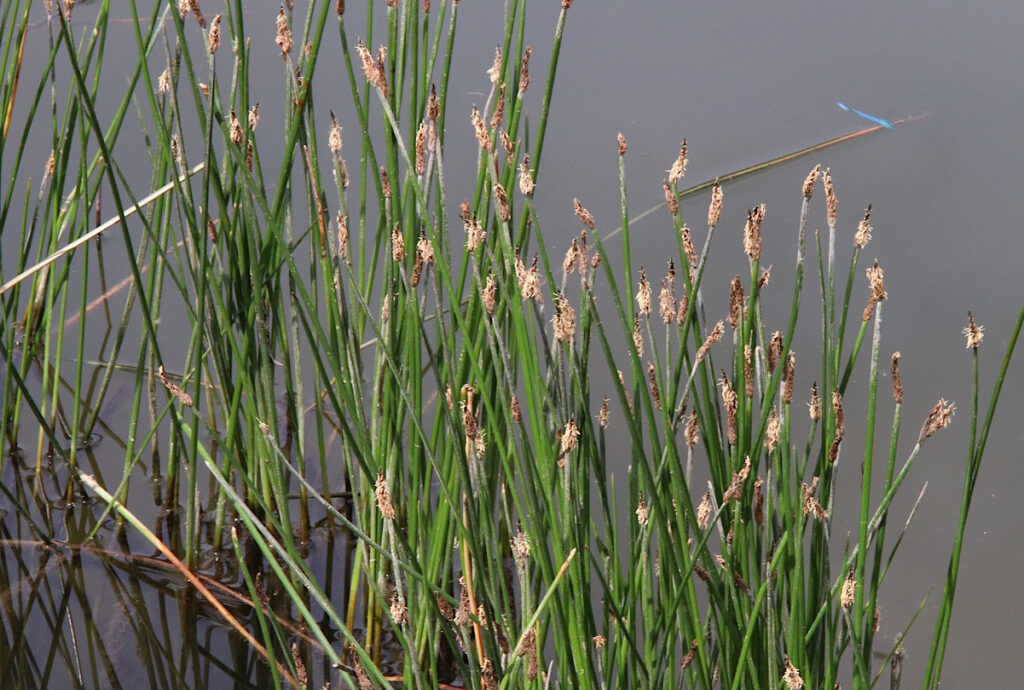
Common spikerush, or Eleocharis acuta, is a native perennial sedge found across NSW, QLD, SA, TAS, VIC, and WA. It grows between 0.3 and 0.9 metres tall, producing fine upright cylinder-shaped stems in a deep green that taper to a fine point at the tip. The flowering stems are hollow and round in cross-section, with a triangular brownish tip as they mature. Flowers are cream-white and stringy, appearing from September through to April.
Despite looking like a grass or rush from a distance, Eleocharis acuta is a sedge, and it behaves like one. It tolerates waterlogged conditions that many grasses can’t handle, and it spreads by both seed and underground stems across the long flowering season.
Is Common Spikerush Actually a Weed?
That depends on your definition. It’s native and ecologically useful. It’s documented as providing bird habitat in dams and ponds, and it’s widely cultivated for this reason. Dam owners who’ve introduced a stand along their bank margin for revegetation were making a reasonable call.
But native status doesn’t mean harmless at any density. Eleocharis acuta can form dense swards quickly in shallow freshwater, and when it does, the problems it creates are the same you’d expect from any dense emergent infestation: deoxygenation of the water and disruption to access and other native vegetation.
That distinction changes the goal. With an exotic species like Phragmites or Salvinia molesta, full eradication is the aim. With a native sedge, managed reduction is usually more appropriate. How much is too much depends on the size and location of the stand.
Where Does Common Spikerush Grow?
Common spikerush establishes in shallow freshwater and consistently wet soil: dam margins, creek banks, swamps and seepage areas, as well as drainage lines. It doesn’t need permanent submersion. The wet and dry boundary zone at the dam’s edge is where it typically colonises first, pushing through damp soil via underground stems and releasing seed for much of the warm-weather period.
Because it’s adapted to the periodic inundation and drawdown that characterises dam banks in agricultural settings, it can hold ground that other wetland plants can’t. Warm water and elevated nutrient levels, particularly on open shallow margins, accelerate growth considerably.
Spikerush weed doesn’t respect the formal boundary of the dam itself. Paddock drainage areas and waterlogged ground near the water are also common colonisation points, which means an infestation can spread well beyond what’s visible from the bank.
When Does Common Spikerush Become a Problem?
A managed fringe of common spikerush at the dam margin is generally fine. The trigger point for active management comes when density tips over into something that’s actively harming the water body or restricting how the property uses the dam.
Dense stands of spikerush weed create a set of issues:
- As the biomass builds and decomposes seasonally, dissolved oxygen drops, placing fish and aquatic life under real stress.
- A solid sward crowds out lower-growing native vegetation, reducing biodiversity along the margin rather than supporting it.
- Thick growth at the dam edge restricts stock water access and creates difficult, boggy ground at the margin.
- Spikerush weed spreads into drainage lines and channels, extending the problem well beyond the main water body.
- Established stands can obstruct irrigation intakes and fittings positioned at the dam edge.
Look out for stands that rapidly expand. A stand that looked contained through winter can form a much broader sward by late summer, particularly in a warm year with good soil moisture.
How to Control Common Spikerush
For a native species, the control scale matters. A fringe covering a small section of bank rarely needs a full herbicide program. A dense sward that’s taking over the marginal zone does.
Physical Removal: Aquatic Weed Hand Cutter
The Aquatic Weed Hand Cutter is the right tool for targeted work on common spikerush stands small enough to manage by hand, or as part of an ongoing maintenance routine between chemical treatments. The serrated blade cuts cleanly through the dense, fibrous stems of spike rush at the waterline.
Cutting alone won’t clear an established stand. The underground stem network survives and produces new growth relatively quickly. The hand cutter is most useful for keeping a fringe from encroaching further into the water, not for clearing a broad infestation. Collect cut material and move it away from the water before seed heads dry and disperse over the surrounding bank.
Chemical Treatment: Knockout Aquatic Herbicide
For established common spikerush infestations where cutting isn’t producing meaningful results, Knockout Aquatic Herbicide is our go-to recommendation. We’ve seen it work consistently on rushes and sedges, and it performs particularly well on taller emergent stands like spike rush. As a glyphosate-based herbicide, Knockout translocates through the leaf tissue to reach the root and underground stem system, rather than just desiccating the visible growth. A contact-only herbicide leaves the rhizome network intact; regrowth follows quickly.
A few things to get right when treating:
- Spray onto actively growing stems during the growing season so the plant can take up and translocate the herbicide.
- Apply on a calm, dry day to maximise contact between the spray and the stem surface.
- Avoid spraying submerged material, as glyphosate becomes inactive in water.
- Follow the product label for rate and any water-use restrictions for your conditions.
Allow time for the treatment to reach the root system before assessing results. Regrowth is possible after the first application, so plan for a follow-up if needed.
Pro Tip: Use Less Herbicide with Biostim Accelerator
Biostim Accelerator is designed to work alongside herbicides, helping them work more effectively so you use less chemical. You use them in tandem, i.e. spray with herbicide then Biostim Accelerator immediately after.
Plants and algae often develop a protective slime layer over their surfaces. This layer can make it harder for herbicides to reach the plant tissue, meaning more chemical is required to penetrate the layer and achieve an effective treatment.
Biostim Accelerator feeds naturally occurring bacteria that break down this slime layer. By reducing this protective barrier, the herbicide can come into contact with the plant more quickly and effectively, reducing the amount of chemical required.
After treatment, Biostim Accelerator helps beneficial bacterial populations break down dead plant material. This reduces the amount of dead organic matter settling on the dam floor and becoming a source of nutrients for future weed growth.
The beneficial bacteria also break down weed seeds and algae spores left behind after treatment. Reducing this material helps limit the potential for new growth.
Preventing Common Spikerush from Spreading
Removal is only half the job. The key to preventing spikerush from coming back is managing the nutrients that fuel plant growth. Aeration and probiotics such as Biostim help radically reduce the nutrient supply available to weeds by encouraging populations of beneficial bacteria.
Aerators add oxygen and improve water movement throughout the dam. This creates the conditions beneficial bacteria need to thrive. Probiotics such as Biostim give these bacteria a further boost, helping build large populations that consume organic matter and excess nutrients in the water.
As beneficial bacteria use up these nutrients, there is less available to fuel weed growth. Over time, this suppresses existing weeds–starving them out of the ecosystem. In simple terms: feed the beneficial bacteria, and they consume the nutrients that weeds need to grow.

Other ways to prevent spikerush returning
- Reduce nutrient input near the dam. Elevated nitrogen and phosphorus drive rapid expansion. Managing fertiliser use near the bank and limiting direct stock access reduces the nutrient load that fuels aggressive growth.
- Revegetate cleared areas. A treated bank left bare is open to reinvasion from seed. Replanting with lower-growing native groundcover competes with re-establishment and stabilises the soil.
- Watch drainage lines from spring onwards. New establishment in channels is far easier to address early, before the plant produces its own seed crop.
- Think upstream. If Eleocharis acuta is present in waterways feeding your dam, seasonal flow will carry seed into your margin regardless of local management.
An aerating fountain reduces the still, nutrient-rich shallow conditions that common spikerush targets as its primary colonisation zone. Water movement and improved oxygenation in the shallows make the margin less hospitable to rapid establishment.
Getting the Balance Right with Common Spikerush
The right question about common spikerush isn’t whether it’s there. For a native wetland sedge, some presence at the dam margin is often fine. The question is whether the density has tipped into something that’s affecting water quality and how you use the property.
We talk with dam owners regularly who’ve been reluctant to treat spikerush weed because it’s native and they didn’t want to pull out a plant that belongs in the ecosystem. That instinct is right up until it isn’t. When a manageable fringe has pushed into the drainage channels and oxygen levels are starting to fall, the fact it’s native doesn’t make the problem smaller.
At Water Quality Solutions, we help property owners work out exactly where that line sits. If spikerush on your dam has moved from a fringe to a feature, get in touch and we’ll work through the right approach together.
FAQs
Is common spikerush native to Australia?
Yes. Eleocharis acuta is a native species found across all mainland states and Tasmania. It has a legitimate ecological role in healthy dam margins and is widely used in revegetation work. A dense infestation affects water quality regardless of native status, and active management is warranted when the stand is causing real problems.
What does common spikerush look like?
It produces fine, upright, deep-green cylinder-shaped stems that taper to a sharp point. The stems are hollow and round in cross-section, with a triangular brownish tip when flowering. Flowers are cream-white and stringy, appearing from September through to April. Common spikerush typically grows between 0.3 and 0.9 metres tall and forms dense stands at waterway margins, in shallow water and waterlogged ground near dams.
Should I remove spikerush weed from my dam?
Not necessarily. A fringe stand of common spikerush at the dam margin often doesn’t need active management, and in some cases it’s worth keeping. The case for treatment builds when spike rush forms dense swards that reduce dissolved oxygen and restrict access, or spread into drainage lines.