
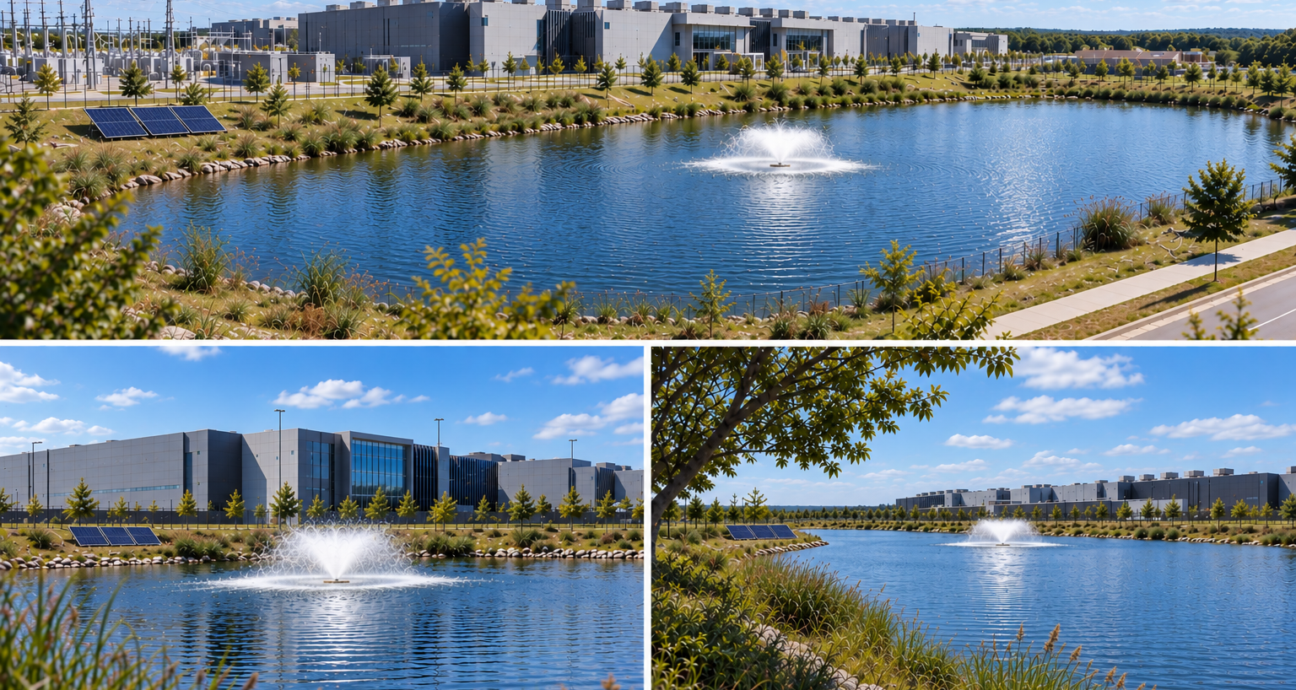
Many large lakes sit a long way from the nearest power point. Others belong to commercial sites where every new connection has to be justified to someone in facilities. Owners in both camps often reach the same idea: let the sun run the aeration.
A solar water aerator is often the most efficient and cost-effective aeration solution for large and commercial lakes. However, you have to make sure the unit suits the lake. Depth, size, shape and sunlight decide which solar aerator is best for your site.
This guide walks you through what solar aerators are, when they’re the best option (for example, for data centre lakes), and how to choose the right one.
What a Solar Water Aerator Does
A solar water aerator moves water so oxygen reaches the layers that usually don’t get much. Still lakes tend to stratify, which means they split into two layers:
- A warm top layer
- A cold bottom layer with more nutrients and less oxygen
Mixing the two keeps the bottom water alive and slows the algae that feed on those nutrients. Solar panels supply the power, so the unit runs on sunlight alone.
Two designs of solar aerator do the mixing:
Surface solar aerators
A surface aerator floats on the water. Its propeller throws water into the air, where it picks up oxygen on the way back down.
It’s the faster of the two designs, and as a solar dam aerator it suits shallow irrigation dams and lakes. Our Carnival, Professional and Commercial aerators all come in solar versions.
We’ve seen these work in commercial settings. Here’s a case study:
Avalon Nursery, near Ballarat, fitted a 1.5hp Carnival, a solar water aerator, to an irrigation dam troubled by red azolla and blue-green algae. Both began retreating within days and had gone after six weeks.
Subsurface aerators with a solar drive
A subsurface solar water aerator keeps the electrics on the bank. A compressor, run by a solar drive, pushes air down a weighted hose to air stations on the lake floor. The rising bubbles lift cold bottom water to the surface and set the whole lake circulating.
It works more slowly than a surface unit, but it suits deeper water and keeps power out of the water. You can convert any Matala or Vertex kit to solar.
Which Solar Dam Aerator Suits Your Water Body?
If you’re weighing up which solar dam aerator to invest in, here’s what you need to consider:
Depth
How deep your lake is is the most significant factor when choosing a solar aerator. As a rule of thumb:
- Shallow water suits a surface unit
- Deep water suits a subsurface one
Above about 5 metres, we generally recommend subsurface aeration. Below that, either type can work. An air station lifts more water the deeper it sits, so a deep lake gets more from every bubble.
Size and panels
A solar aerator generally needs a bigger motor than a mains unit to cover the same area. A 1hp mains Carnival covers up to half an acre, while the solar range needs the 1.5hp model for that half acre.
Solar Carnivals run from 1hp (up to a third of an acre) to 3hp (up to one acre). A solar water aerator’s panel count climbs with the motor, from as few as 2 to around 10. Subsurface kits cover more ground per unit, up to 4 acres in the large Matala and Vertex kits.
Shape and dead zones
Water doesn’t turn corners. A single solar pond aerator in the middle of a long, narrow lake leaves both ends short of oxygen. An L-shaped lake needs a unit in each arm.
Refer to our aeration placement guide for more advice on where each station should go.
Here’s an estimate of the kinds of solar aerators you should be looking at based on your water body:
| Water body | Suggested solar unit | Area per unit |
| Shallow pond or dam | Carnival or Professional, 1hp | Up to ⅓ acre |
| Shallow dam | Carnival, Professional or Commercial, 1.5hp | Up to ½ acre |
| Shallow lake | Carnival or Commercial, 3hp | Up to 1 acre |
| Deeper dam or lake | Small to large Matala or Vertex kit | ¼ to 4 acres |
| Beyond 4 acres | Several units, or a custom Vertex design | Designed per lake |
Where a Solar Pond Aerator Falls Short
A solar pond aerator needs sun. It stops at night and slows under heavy cloud. Our standard solar systems run straight from the panels and don’t store energy, so nothing keeps them going after dark.
That matters because oxygen in a lake is usually lowest just before dawn. Fish, plants and algae use it up overnight, with no photosynthesis to replace it. A lake with a heavy fish stock, or one that has crashed overnight before, needs aeration through those hours.
Our direct-solar systems run for about 5 to 8 hours a day, and up to 10 in summer. But season, location, cloud, shading, panel orientation, array size and the aerator and controller all affect that.
No solar powered water aerator can run in the dark, but you have options. A larger unit moves more water while the sun is up. A hybrid AC/DC setup draws on mains power while the sun’s down. For a subsurface system, a mains compressor can sit beside a power outlet up to 200 metres from the lake. Air then travels to the water through a buried hose.
We’ll also tell you when solar is the wrong choice. If mains power already runs close to the lake, mains is simpler. The same goes for a lake that needs round-the-clock aeration for its fish, or one where trees or buildings shade the only spot for panels.
Solar Powered Water Aerators for Commercial and Industrial Sites
Why commercial sites choose solar aerators
Solar is often much quicker and cheaper for large sites. Running mains to a lake at the far end of a large site means trenching, cabling and an electrician’s time. A solar pond aerator skips all of it and adds nothing to the site’s electricity load.
Surf Coast Shire has two 3/4hp solar Aquarian Professionals on a 600 m², 2 m deep leachate pond at Anglesea Landfill and Transfer Station. They are there to help control its high BOD and COD and meet trade waste limits.
Data centres as a use case
Data centre campuses often include an on-site lake, usually a stormwater or amenity lake, and operators have to watch their energy use closely. Solar powered water aerators are perfect because they look after the water without adding to the power load.
Picture a three-acre amenity lake at the back of a campus, with no power nearby. A large solar subsurface kit, rated for up to 4 acres, would cover it, with panels on the bank and air stations on the floor. Our guide to stormwater pond aeration covers the problem from the basin side.
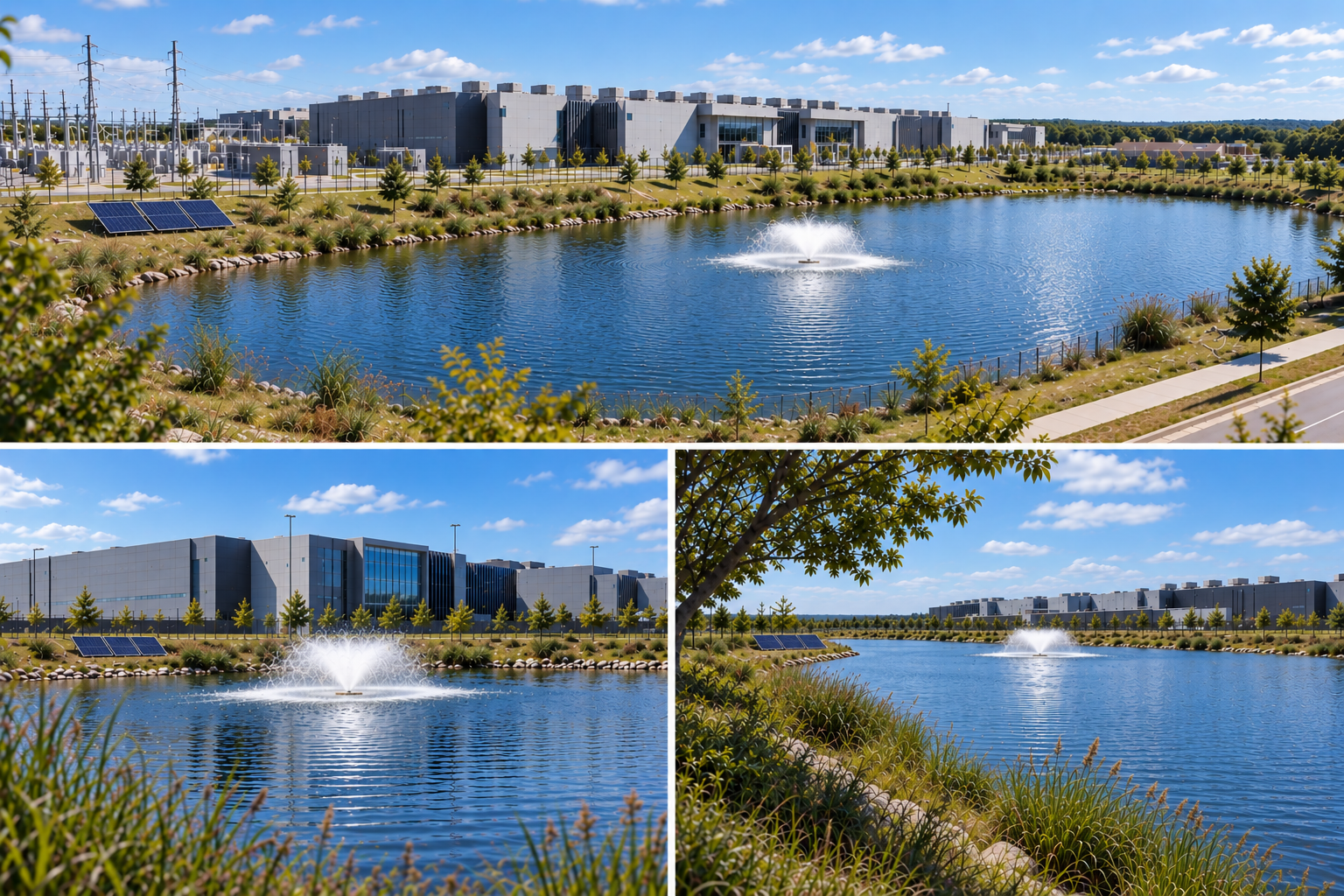
Image: llustrative rendering of a solar-powered Air-O-Lator Carnival Aerator installed in a data centre campus lake.
Layouts for large lakes
You can use several units to share the work on a large site. Our Dalton Lake project in Queensland shows how:
The lake covers more than 6 acres, sits beside a commercial estate, and its top and bottom water rarely mixed. We installed a Vertex system with five quad disc air stations. Three months later, bottom-water ammonia had fallen by 99% and phosphorus by 95%. Nitrogen had dropped by 83%.
Whatever powers the system, the layout rule is the same: start at the deepest point, then space stations to suit the shape. A solar water aerator adds one constraint. Solar surface kits come with a 30-metre cable as standard, so the panels must sit within that reach of the unit.
Running Costs and Maintenance for a Solar Water Aerator
Sunlight is free, so a solar powered water aerator has no electricity bill. The running costs are servicing and spare parts (check panels for dirt, debris, damaged cabling and loose connections).
On a surface unit, regularly inspect:
- The motor
- The intake
- The propeller
- The float
On a subsurface unit:
- Replace the air filters
- Clean the biofilm (the slimy bacterial layer) off the diffusers
- Keep the compressor free of debris
We supply the manufacturer’s warranty details with every quote.
Start With the Lake, Then Choose the Panels
A solar water aerator is often the best pick when the lake’s depth, size and shape are appropriate and main supply is tricky. Shallow lakes suit surface units, deep lakes suit subsurface systems, and long or large lakes often need more than one. Where solar falls short at night, you can often build a larger unit or a hybrid setup instead.
At Water Quality Solutions, we’ve been helping dam, lake and lagoon owners across Australia with aeration for over fifteen years. Send us your lake’s size, depth and location, and we’ll be happy recommend the right system.