
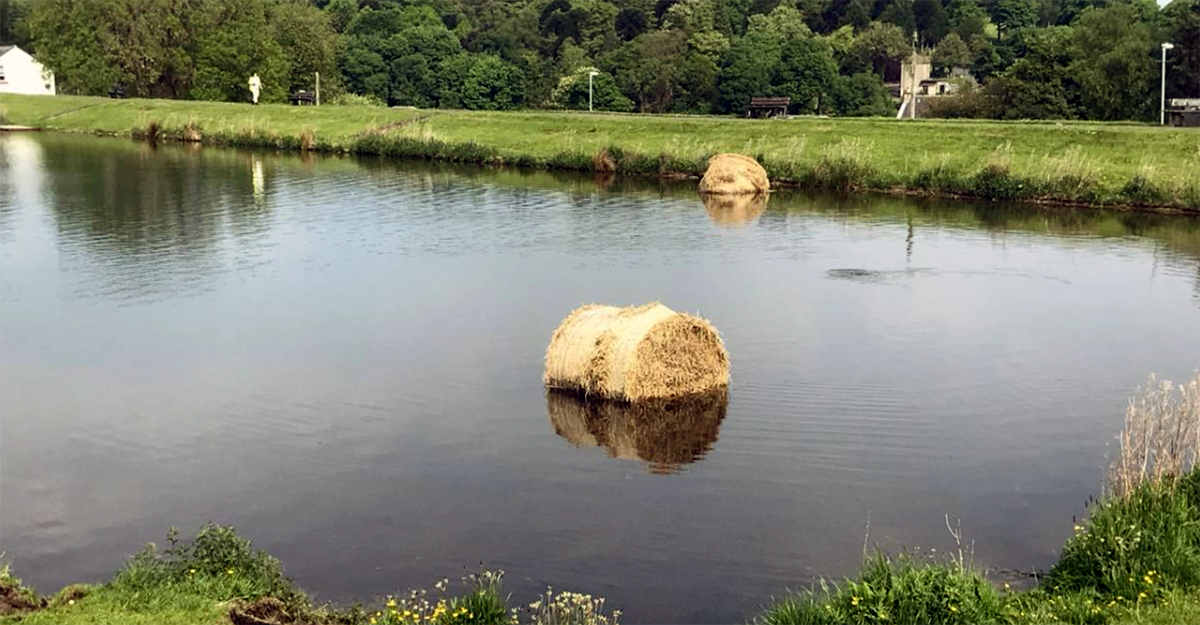
For years, pond and dam owners have turned to barley straw as a ‘natural’ way to control algae growth. The claim is simple: toss a few bundles of straw into your water, and over time, the algae will vanish.
But does it actually work, especially in large ponds or farm dams?
Let’s dig into the actual science. In this article, we’ll explore the thinking behind why and how this theory became so popular, before exposing the reality behind its limitations. And we’ll also explain why a peroxide-based treatment such as AlgaeLift is a far more reliable alternative.
The Promise: Barley Straw as a Natural Algaecide
The origin of this folktale is often attributed to the UK in the mid 1990s, when a British farmer accidentally dropped a bale of barley straw into a pond riddled with algae. Rather than immediately moving it, he allowed the barley straw bale to sit there and, over time, the algae disappeared. The practice was eventually adopted in large reservoirs across England, such was its prevalence.
The allure of barley straw for ponds is strong. It’s cheap, organic, and seen as a chemical-free solution to algae problems. In DIY forums and backyard pond guides, it’s often lauded as a benign, set-and-forget method to keep pond water clear.
From a marketing perspective, the angle is strong. Barley straw bales check all the boxes: low cost, ‘natural, and low maintenance (in theory). But in practice, does barley straw work?
The Theory: How Barley Straw Supposedly Works
The usual explanation for how barley straw decomposes matter in pond water goes something like this:
– Decomposition: Barley straw, like most organic material, begins to break down and decompose when submerged in well-oxygenated water.
– Release of natural compounds: As it decays, the straw releases humic acids, phenols, and other organic compounds.
– Generation of trace hydrogen peroxide: Under the right chemical conditions, some of those compounds can transform into low levels of hydrogen peroxide. This mild, oxidising agent may exert a weak inhibitory effect on certain algae species, especially free-floating green algae.
The effect is noted as being gradual and preventative rather than an outright destroyer of algae blooms. However, for the chain of events to take place, many factors must align including an adequate level of oxygenation, a moderate water temperature range, the correct water chemistry, and sufficient quantities of disposable straw.
With all of this in place, there is some merit to the theory.
The Reality: Barley Straw Falls Short
Barley straw extract may have occasional minor impacts on small, controlled pond areas. But for large water bodies, it’s largely ineffective and impractical for a number of reasons.
It’s Labour Intensive
The unfortunate reality is that you need a lot of bales for this to even have a chance of working for your algae control. You must place straw bundles evenly throughout the pond, anchor them, and replace them periodically. In a big, deep pond, this is a logistical nightmare.
It Doesn’t Clear Existing Algae
Straw is only claimed to prevent or slow new growth. So if your pond is already green, it won’t have any meaningful impact on killing what’s already there and improving water clarity.
Results Are Inconsistent
Some users have historically sworn by this method. Others avoid it entirely, claiming limited credible results. And small changes in temperature, oxygen, or water chemistry can make it fail entirely. This is especially true for large dams and ponds, where positive results are non-existent.
It Can Worsen Water Quality
As straw rots, it releases certain organic matter and nutrients such as nitrogen and phosphorus. These are proven to speed up algae growth rather than suppress it.
Mild Hydrogen Peroxide Levels (At Best)
Even when the straw produces peroxide, the concentration is so low it barely affects algae (especially in large bodies of water). To scale it up, you’d need impractical levels of straw, at which point some of the other decomposition issues mentioned will begin to dominate.
Because of these drawbacks, relying solely on barley straw in a large dam or pond is often disappointing.
A Cleaner, Faster Alternative: AlgaeLift
So if barley straw is not the heralded solution to stopping algae blooms, is there a credible alternative?
Many pond owners opt for AlgaeLift instead. This is our peroxide-based granular product designed to speed up the removal of algae growth in much the same way as barley straw. However, the process is slightly different, and it comes with the following benefits:
– Peroxide-based action: AlgaeLift is a peroxide treatment that ‘lifts’ algae from surfaces such as rocks, floors, and other plants. Then natural processes (e.g. bacteria already in the ecosystem) can break it down further.
– Not a bacterial inoculant: It is not designed to introduce bacteria into a water system. Rather, it uses a chemical oxidiser (peroxide) to dislodge algae from surfaces.
– Safe, decomposition by-products: AlgaeLift breaks down into hydrogen, oxygen, and water – there are no harmful residuals when applied.
– Quick results: The major difference between AlgaeLift and barley straws is the speed at which it works. Users report visible algae detachment within minutes in many cases. The dislodged algae floats free and can then be removed manually or left for natural decomposition.
– Targeted application: You only need to treat areas affected by algae, rather than dosing the entire area of water.
For large bodies of water, guidelines recommend a dosage of 6kg-36kg per megalitre of water for full treatment, or 9kg-45kg per surface acre for surface water treatment.
Comparison Chart
| Barley Straw | AlgaeLift | |
| How it Works | Decomposes slowly in oxygenated water, releasing trace amounts of hydrogen peroxide to inhibit algae growth. |
Direct oxidation that lifts algae from pond and dam surfaces for rapid control. |
|
Effectiveness |
Inconsistent with many variables needed to align. |
Consistent and predictable – not reliant on external factors. |
|
Speed of Results |
Very slow – may take 6-8 weeks to show any change. |
Fast – starts working within minutes of contact. |
|
Ease of Use |
Labour-intensive. |
Simple to apply. |
|
Environmental Impact |
Nitrogen and phosphorus release – can speed up algae growth. |
No harmful residues – breaks down into hydrogen, oxygen, and water. |
|
Treatment Type |
Mild, slow-release hydrogen peroxide.created naturally during decomposition. |
Controlled, concentrated hydrogen peroxide release for immediate oxidation. |
|
Maintenance Required |
High – consistent straw replacement needed. |
Low – reapply as needed for spot treatments – no debris or cleanup. |
|
Best Use Case |
Very small, decorative ponds. |
Farm ponds, dams, and larger bodies needing fast, predictable algae control. |
Tackling the System and Cause
While not a complete myth, it’s clear that barley straw, as a long-term solution for your algae problems, is not suitable in many cases. It’s only capable of working across small, concentrated areas. And the cost of maintaining a steady supply of bales will likely be significant.
AlgaeLift, on the other hand, gets to work immediately and goes a long way towards producing clean and clear water. It’s harmless to your water systems and aquatic life and does not introduce new bacteria, which can disrupt ecosystems.
However, while AlgaeLift is very effective at what it does, it doesn’t address the initial cause of the problem–namely, the conditions that allow algae to grow in the first place. It’s why we recommend using AlgaeLift in combination with effective aeration of your waterways, as well as a reliable probiotic such as Biostim to starve algae of the excess nutrients it needs to grow in the first place.
When used as one, you’ll have a winning solution that requires minimal maintenance and can help to remove the chances of algae build up.
Get FREE Expert Advice
We’ve been offering simple and expert advice on how to remove algae from water systems for over 15 years. We’ve seen it all, so there’s no water issue we won’t be able to help you with.
Request a callback today if you’re having issues with excessive algae growth. We’re happy to provide FREE advice on all of your natural and chemical treatment options to combat algae.