
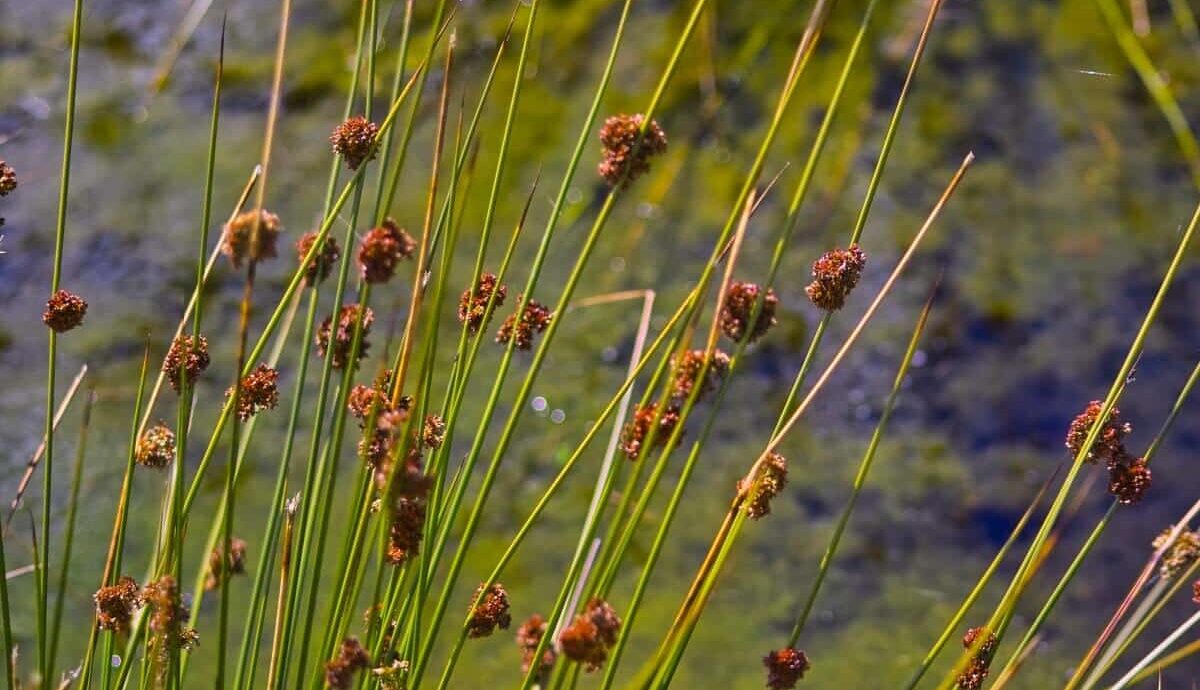
If you’ve noticed dense clumps of reed-like growth along the edge of your dam, there’s a good chance you’re looking at common rush weed. It’s one of the most common aquatic plants on Australian dams and waterways. It’s also one of the most commonly misidentified.
Many landholders assume it’s harmless because it’s native. That’s partly true. But a native plant can still become a management problem when it establishes in the wrong place or spreads without check.
Read on for a practical guide to rush weed control: what it is and what to do about it.
What Is Common Rush?
Common rush (Juncus usitatus) is a native emergent plant that grows across New South Wales, Queensland, South Australia, Victoria, and Western Australia. It grows in cylindrical green stems reaching up to 1.2 metres in height. It has no true leaves. The stems are smooth and round, tapering to a soft point at the tip.
As an emergent aquatic plant, common rush roots below the waterline and grows up through the surface. It has a long history in Australian landscapes: Indigenous communities have used it for basketry and weaving for generations, and in balanced waterway systems it can play a genuine ecological role. The problem arises when conditions allow it to dominate.
Where Does Common Rush Grow?
Common rush favours dam margins, stream banks, and ground that experiences seasonal flooding or disturbance. It does particularly well in soil that stays waterlogged for part of the year. That makes dam edges an ideal habitat.
It spreads mostly through seed. Birds and water currents carry those seeds across considerable distances, so a small stand near your dam’s inlet can become a well-established spread across the bank within a season or two if conditions stay wet.
How to Identify Common Rush
Look for these features to confirm common rush:
- Round, uniformly green stems with no flat leaf blades, ridges, or rough edges along the surface
- Flexible rather than brittle stems, tapering to a soft point at the tip
- Dense, upright tufts of growth reaching up to 1.2m tall
- A fibrous root mat at the base, with no visible creeping rhizomes
Two species are often mistaken for common rush. Common spikerush (Eleocharis acuta) looks similar but stays shorter and produces a single small spikelet at each stem tip. Giant sedge (Cyperus exaltatus) grows taller, up to 1.5 metres, with a distinctive umbrella-shaped flower head.
If you’re not certain which you’re dealing with, get a firm ID before you treat. Applying a weed killer for rushes to the wrong species can waste time and money.
Does Common Rush Have Any Benefits?
Before reaching for any treatment, it pays to understand what common rush does when it’s behaving itself. Its root system stabilises bank margins and reduces erosion, which matters on properties where stock pressure or seasonal flooding has loosened the soil. Above ground, it provides cover and foraging habitat for waterbirds.
Common rush is not a weed in every situation. In a functioning wetland system, it earns its place. The question is whether it’s earning its place in your dam.
When Does Common Rush Weed Become a Problem?
Common rush weed becomes a management concern when it forms dense, spreading stands that interfere with how your dam functions. A few plants scattered along the bank is rarely cause for action. A stand running across a large portion of your margin is a different matter.
Left unchecked, the effects compound quickly:
- Dense stems shade out other aquatic vegetation, reducing plant diversity along the bank
- The root and stem mass slows flow, blocking irrigation intakes and stock watering points
- In heavy infestations, decaying material depletes dissolved oxygen near the dam bed, putting fish and other aquatic life under stress
- On a practical level, stock struggle to reach the water and inlet pipes need clearing every other week
We regularly hear from dam owners who’ve been working around common rush weed for a season or more before treating it, and who find the job considerably harder by that point. Catching it early makes a real difference.
Rush Weed Control: How to Remove Common Rush from Your Dam
The right approach to rush weed control depends on the scale of what you’re dealing with. A handful of plants along a short stretch of bank is a very different problem from an established stand that’s taken over a large section of the edge.
Physical Removal: Aquatic Weed Hand Cutter
For mild infestations, physical removal is a practical first option. The Aquatic Weed Hand Cutter has a serrated blade that cuts through rush stems at and below the waterline. You can also use a brush cutter (if you can keep the blades far out of the water).
Clear the cut material from the water as you go. Even small stem fragments left floating can settle back into the bank margin and regrow.
This approach works well in smaller areas, around dam infrastructure, or where chemical treatment isn’t appropriate, such as near stock drinking points.
The limitation is that cutting above-ground growth leaves the root system intact. Common rush regrows from those roots. Physical removal is most effective when combined with a weed killer for rushes, or as ongoing maintenance after an initial treatment has knocked back the main stand.
Chemical Treatment: WaterTreats Aquatic Weed Killer
For moderate to severe infestations, WaterTreats Aquatic Weed Killer is the most effective chemical option for quickly killing common rush weed. It works on contact: when sprayed directly onto the stems and leaves, it’s rapidly absorbed and produces peroxide that desiccates plant tissue and disrupts cell membranes. Apply it during active growth, with spring and early summer giving the best results.
Because it works on contact rather than through the root system, coverage of the above-ground stems is what matters. Spray directly onto the green growth, wetting the stems thoroughly. In areas with water movement that might reduce contact time, the product can be used with AquaSticker to improve adhesion. Clear water gives better results, as suspended particles can interfere with the herbicide’s action.
As treated vegetation breaks down, dissolved oxygen in the water can drop. Avoid treating more than a quarter of the affected area in a single application, and wait until that section has fully broken down before moving to the next. Don’t use dam water for swimming or irrigation for 10 days after treatment.
Before applying any weed killer for rushes, check the product label for application rates, as dose varies depending on infestation type and water conditions.
Pro Tip: Use Less Herbicide with Biostim Accelerator
Biostim Accelerator is designed to work alongside herbicides, helping them work more effectively so you use less chemical. You use them in tandem, i.e. spray with herbicide then Biostim Accelerator immediately after.
Plants and algae often develop a protective slime layer over their surfaces. This layer can make it harder for herbicides to reach the plant tissue, meaning more chemical is required to penetrate the layer and achieve an effective treatment.
Biostim Accelerator feeds naturally occurring bacteria that break down this slime layer. By reducing this protective barrier, the herbicide can come into contact with the plant more quickly and effectively, reducing the amount of chemical required.
After treatment, Biostim Accelerator helps beneficial bacterial populations break down dead plant material. This reduces the amount of dead organic matter settling on the dam floor and becoming a source of nutrients for future weed growth.
The beneficial bacteria also break down weed seeds and algae spores left behind after treatment. Reducing this material helps limit the potential for new growth.
Preventing Common Rush from Returning
Removal is only half the job. Common rush produces large quantities of seed, and bare, disturbed banks after clearing can create ideal conditions for it to re-establish.
The key to preventing it from coming back is managing the nutrients that fuel plant growth. Aeration and probiotics such as Biostim help radically reduce the nutrient supply available to weeds by encouraging populations of beneficial bacteria.

Aerators add oxygen and improve water movement throughout the dam. This creates the conditions beneficial bacteria need to thrive.
Probiotics such as Biostim give these bacteria a further boost, helping build large populations that consume organic matter and excess nutrients in the water.
As beneficial bacteria use up these nutrients, there is less available to fuel weed growth. Over time, this suppresses existing weeds–starving them out of the ecosystem. In simple terms: feed the beneficial bacteria, and they consume the nutrients that weeds need to grow.
For the best long-term results, combine biological management with good bank management. Avoid unnecessary soil disturbance around the water’s edge after clearing, and where practical, establish lower-growing, competitive ground cover to stabilise bare areas.
Finally, check your dam margins at least once a season. Common rush is much easier to manage when it is a few scattered young plants than when it has developed into a metre-high stand with an established root system beneath it.
Getting Rush Weed Under Control
Common rush has a genuine place in the Australian landscape. Managing it around your dam isn’t about eliminating it entirely. It’s about keeping growth at a level that doesn’t interfere with water access, dam function, or the health of the aquatic environment.
At Water Quality Solutions, we’ve been helping dam and waterway owners across Australia with rush weed control for over fifteen years. If you’re dealing with common rush weed and aren’t sure where to start, get in touch with us and we’ll help you work out the right approach for your situation.
FAQs
Is common rush the same as common reed?
No. Common rush (Juncus usitatus) and common reed (Phragmites australis) are separate species. Common reed grows up to 3 metres tall and produces large, feathery seed heads on hollow stems. Common rush is shorter, grows in round leafless stems, and has no prominent seed head. Both are native to Australia and both can become problematic in dam settings, but they’re easy to tell apart once you know what to look for.
Is common rush weed native to Australia?
Juncus usitatus is native and grows across most Australian states. Being native doesn’t mean it can’t cause problems in a dam setting. When common rush weed takes over a large section of dam margin, the practical consequences are the same: blocked intakes, reduced water access, and interference with dam function, regardless of where the plant originally came from.
Can I remove common rush without a weed killer?
Yes. Physical removal and a treatment plan (usually involving aeration and probiotics) to reduce nutrients in the water will eventually starve plants out of a water body. Aeration adds oxygen and improves water movement, while probiotics such as Biostim boost beneficial bacteria that consume organic matter and excess nutrients. As nutrient levels fall, weeds begin to starve to death. And the best bit, they don’t come back, which is different to spraying with herbicide (the weeds always come back).