
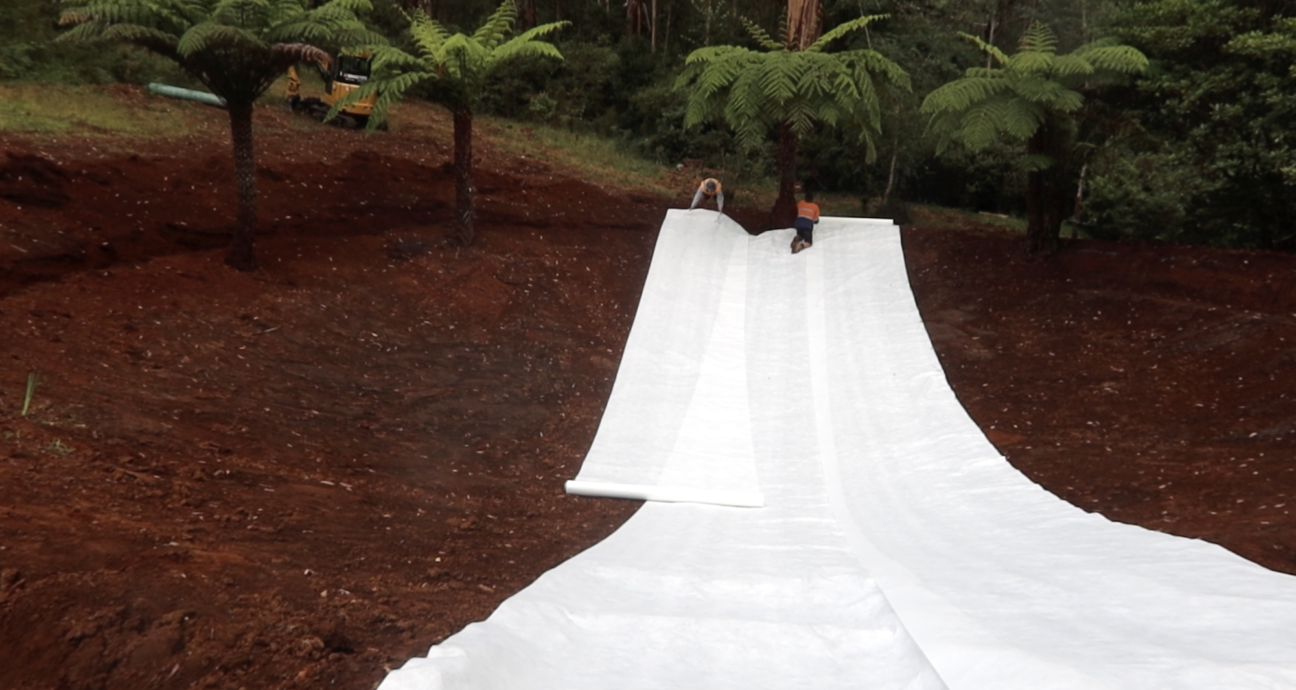
There are lots of components to a proper dam or pond build. Some can be unexpected. For example, you might examine your quote and see both liner and underlay. You might be asking what the difference is. Is it an upsell?
It’s usually not. Dam or pond underlay is often an essential part of the build. A short list of cases can skip it (we’ll cover those below), but for everything else, it’s a good idea. A layer of fabric costs far less in the long run than the job of draining a dam to find a hole.
This guide covers what pond underlay does and when you need it. It also explains why old carpet is a poor shortcut and how to pick the right weight.
What Pond Underlay Does
Pond underlay is a layer of geotextile (a strong, porous fabric) that sits between the ground and the liner. The pond underlay we sell is made from UV-stabilised polyester, which doesn’t rot the way natural fibres do. Its job is to cushion the liner from stones, roots and rough ground.
That matters because a full dam presses down hard. Water sits on the liner and pushes it into whatever lies beneath. A small sharp stone that seems harmless in an empty hole can work through the sheet over time and cause a leak.
Underlay has limits, though. For example:
- It doesn’t fix a badly prepared base
- It won’t stop a large rock or a root pushing through
You still need to clear the base properly before it goes down. Think of pond underlay as the second line of defence. Ponds with liners still need a clean base first.
Do You Need Underlay Under a Dam or Pond Liner?
Our Rollgum installation guide recommends underlay in most cases. Walk around your excavation and check it against four conditions:
- Stony ground: Stones, gravel or broken rock anywhere in the base or walls.
- Roots: Old roots in the floor or sides, especially from trees nearby.
- A rough or uneven base: Lumps, ridges or hollows you can feel underfoot.
- Steep sides: Slopes where the liner will strain against whatever sits behind it.
If you’ve noticed any of these, use underlay.
When you can skip it
There are a few exceptions to the ‘always use pond underlay’ rule. The main examples are these:
- A base that is genuinely smooth and made of fine, even soil, with no stones or roots anywhere and gentle slopes, can reasonably go without.
- You might not need underlay for a short-lived water body where a puncture would be cheap to fix.
Even then, we lean towards using pond underlay. A pond liner is hard to reach once it’s filled, so the extra layer is cheap insurance.
Years ago, we did a large dam installation for a landscape company on the Mornington Peninsula. Once it was finished, we got a call to say it was leaking. After weeks of investigation, including diving the dam to check all our seams, the client hired a company to remove some of the many rocks piled on the liner. They found several tears, caused by rough handling and too little pond underlay.
Can You Use Old Carpet Under a Pond Liner?
People often try this because it’s free and it seems like the same thing. We wouldn’t. Old carpet under a pond liner causes four big problems:
- Rot: Natural fibres and jute backing break down in damp ground, leaving lumps and voids.
- Tacks and staples: These are easy to miss and can puncture the liner from below.
- Moisture: Carpet holds water against the liner and the ground.
- Lumps: It packs down unevenly and leaves ridges under the sheet.
Some people use sand and newspaper, too. Both are bad ideas: sand slides to the bottom of a slope and hides sharp points instead of removing them, and newspaper breaks down quickly. Neither will do the same job as geotextile.
Our verdict: use geotextile. Carpet might work in one case: a small, short-term garden pond, with clean synthetic carpet and every tack and staple removed. We’d still pick fabric made for the job.
Choosing the Right Underlay: 150gsm or 300gsm
Underlay weight is measured in gsm (grams per square metre). A higher number means a thicker, heavier fabric with more cushioning. LMD sells pond underlay in both 150gsm and 300gsm, in 2 m by 50 m rolls.
When 150gsm is enough
If you’ve chosen a liner for a pond, our rule of thumb is 150gsm. It’s enough on a properly prepared base: fairly even, soft ground cleared by hand, with no more than the odd small stone and gentle slopes.
When to step up to 300gsm
We use 300gsm for dams, and for any base with rough material such as stones or roots, steep sides or ground you can’t fully clear. The choice rests on substrate, loading and puncture risk, not surface area.
Neither grade makes it safe to leave sharp rocks in place, and heavy loads or difficult ground may need extra protection or a designed solution.
How much to order
Each roll covers 100 square metres, or you can order cut-to-length (in both 150gsm and 300gsm). Here’s a quick step-by-step to work out how much to buy:
- Work out the area of liner you’re covering
- Then add extra for overlaps between sheets and for the strips that run into the anchor trench
- Divide by 100 and round up to the next whole roll.
Don’t order short. You can’t patch a gap once the liner is down.
Ponds With Liners: How to Lay Underlay
On ponds with liners, lay the underlay before anything else. With dams, the step comes later, as there’s more prep work to do.
Work from the top of the dam down. Lift each sheet away from the contours until you reach the deepest part of the excavation, so it sits flat without bridging hollows. Overlap the sheets and keep them in place. Heat-fusing the joins works well, and sandbags hold the fabric down if the wind picks up.
Don’t trim the underlay close to the edge. The extra fabric runs into the anchor trench, which is about 30 to 40 cm wide and deep. That keeps it in place under the liner’s edge. Walk the base once the fabric is down and before the pond liner goes on. Any lump you feel through your boots is a stone or root you should remove.
Spend a Little Extra Where You Can’t Reach Later
Choosing a liner for a pond or dam is a one-time decision, and underlay is its main protection, so take the time to get it right. Always use pond underlay unless your base really is smooth and clear. Whichever liner for a pond you buy, it can only be as good as the ground beneath it. Pick 150gsm for ponds and 300gsm for dams or rough ground. Don’t be tempted to use carpet or sand, as neither will fully protect your liner.
At Water Quality Solutions, we’ve been helping dam, lake and lagoon owners across Australia with liners and aeration for over fifteen years. Tell us your liner size and site conditions and we’ll be happy to recommend the right underlay.