
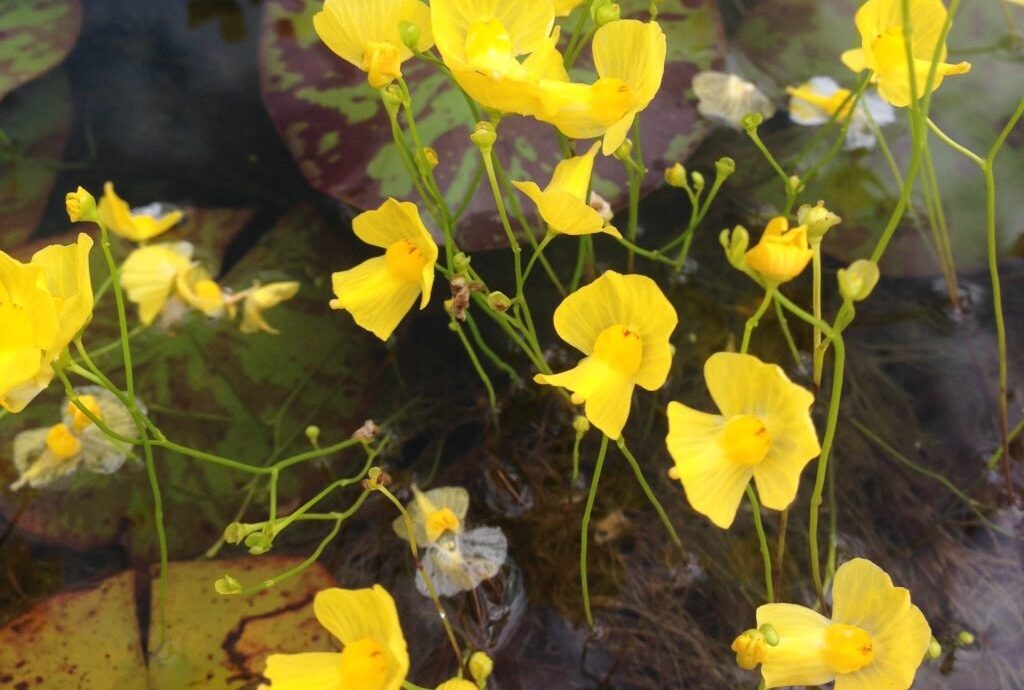
Most dam owners who notice yellow bladderwort first see the tiny yellow flowers above the waterline and assume it’s a minor surface plant. What’s harder to see is everything below: a free-floating network of stems and microscopic bladder traps that has been quietly colonising the dam.
It’s native, it’s one of Australia’s few carnivorous aquatic plants, and at low density it’s genuinely useful. Dense stands are a different matter.
Here’s what you need to know about managing a healthy bladderwort stand.
What Is Yellow Bladderwort?
Yellow bladderwort (Utricularia gibba ssp. exoleta) is a native Utricularia bladderwort species found across NSW, QLD and WA. It floats freely below the water’s surface, often tangled around other submerged vegetation or structures. The only part of the bladderwort plant that breaks the surface is its small, bright yellow flowers, which appear on thin stalks during the flowering season.
The stems carry tiny bladder-like structures, the traps that give the plant its name. These are essentially snares: when a small aquatic organism such as a mosquito larva or water flea brushes against the trigger hairs, the trap snaps open and draws the prey inside. The plant absorbs nutrients from the captured organism.
This dual feeding strategy makes the yellow bladderwort plant unlike almost anything else you’ll encounter in an Australian dam. It can photosynthesise like any plant, but it also supplements its nutrition by trapping live prey. This is why Utricularia bladderwort thrives in low-nutrient water bodies where other plants struggle.
Reproduction occurs through seed when flowers are pollinated by insects, and asexually through winter buds. Fragments and seeds are dispersed by water currents and animals.
Is Yellow Bladderwort Good or Bad for Your Dam?
At low density, the bladderwort plant is useful. The submerged portion provides critical habitat and food for native fish, frogs and other aquatic life. Its carnivorous feeding habit actively reduces mosquito larvae and water fleas in the dam, which is a real benefit around a working farm property.
The problem comes when growth tips past the point where those benefits are outweighed by the effects on dam function:
- Dense floating mats block pump intakes and filters, often without obvious warning until performance drops.
- A dominant stand crowds out other native aquatic vegetation, reducing biodiversity in the water body.
- Thick coverage restricts stock water access and makes the dam difficult to use for swimming or fishing.
- As seasonal growth dies back and decomposes, dissolved oxygen drops, placing fish and aquatic life under stress.
Yellow bladderwort doesn’t need to be eradicated; it needs to be managed at the right density.
When Should You Remove Yellow Bladderwort?
A light, scattered presence doesn’t require immediate action. The bladderwort plant is doing useful work at low density, and removing it entirely isn’t ecologically necessary.
The threshold for intervention is when the stand is large enough to affect how the dam functions. Signs that action is warranted:
- Yellow flowers are clustered across a significant area rather than appearing occasionally at the margins.
- Pump performance has dropped or intakes are showing partial blockage.
- Submerged mats are visible from the bank or restricting livestock access to the water.
- The stand has grown noticeably between seasons and shows no sign of slowing.
Because yellow bladderwort floats freely rather than anchoring into the dam floor, a growing stand can expand its coverage quickly when conditions are right. Acting when density first becomes a concern is much easier than responding to a fully established stand.
We hear from dam owners who’ve watched the yellow flowers for a season without realising how much growth has accumulated below. By the time the pump starts struggling, the plant is already well established.
How to Control Yellow Bladderwort
Because yellow bladderwort floats in the water column rather than rooting into substrate, contact time with any herbicide or physical removal effort matters more than with anchored weeds.
Physical Removal: Aquatic Weed Hand Cutter
Cutting a free-floating plant presents a different challenge to working on a rooted or emergent species. With yellow bladderwort, the Aquatic Weed Hand Cutter does the initial work, but the plant doesn’t stay where you cut it. The loosened material needs to be raked to the bank immediately and physically removed from the water.
That step matters more here than with most weeds. Yellow bladderwort reproduces through fragments and winter buds, and cut pieces left floating in the dam will drift and re-establish. Work a section at a time, clear as you go, and dispose of everything well away from the dam edge. For a large or established stand, physical cutting works best as a first pass before a chemical treatment program rather than as the sole control method.
Chemical Treatment: WaterTreats Aquatic Weed Killer
Yellow bladderwort presents a particular challenge for herbicide treatment: the target is moving. Because the plant floats freely rather than anchoring to the dam floor, there’s no fixed point to direct treatment at. Getting consistent coverage across the water column is the priority.
WaterTreats Aquatic Weed Killer is what we use in these situations. It works on contact with plant tissue, so the aim is maximising the time the herbicide stays in contact with the growth below the surface. Treat no more than a quarter of the dam in one application to avoid a sharp drop in dissolved oxygen as the plant dies back. A 10-day withholding period applies for stock watering, irrigation and recreational use. Check the product label for application specifics relevant to your conditions.
Pro Tip: Use Less Herbicide with Biostim Accelerator
Biostim Accelerator is designed to work alongside herbicides, helping them work more effectively so you use less chemical. You use them in tandem, i.e. spray with herbicide then Biostim Accelerator immediately after.
Plants and algae often develop a protective slime layer over their surfaces. This layer can make it harder for herbicides to reach the plant tissue, meaning more chemical is required to penetrate the layer and achieve an effective treatment.
Biostim Accelerator feeds naturally occurring bacteria that break down this slime layer. By reducing this protective barrier, the herbicide can come into contact with the plant more quickly and effectively, reducing the amount of chemical required.
After treatment, Biostim Accelerator helps beneficial bacterial populations break down dead plant material. This reduces the amount of dead organic matter settling on the dam floor and becoming a source of nutrients for future weed growth.
The beneficial bacteria also break down weed seeds and algae spores left behind after treatment. Reducing this material helps limit the potential for new growth.
Preventing Yellow Bladderwort from Returning
Removal is only half the job. The key to preventing yellow bladderwort from coming back is managing the nutrients that fuel plant growth. Aeration and probiotics such as Biostim help radically reduce the nutrient supply available to weeds by encouraging populations of beneficial bacteria.
Aerators add oxygen and improve water movement throughout the dam. This creates the conditions beneficial bacteria need to thrive. Probiotics such as Biostim give these bacteria a further boost, helping build large populations that consume organic matter and excess nutrients in the water.
As beneficial bacteria use up these nutrients, there is less available to fuel weed growth. Over time, this suppresses existing weeds–starving them out of the ecosystem. In simple terms: feed the beneficial bacteria, and they consume the nutrients that weeds need to grow.

Keep Your Bladderwort Working For You, Not Against You
The yellow flowers are the most visible part of the plant, but they appear late in the growth cycle. By the time the flowers show in numbers, a significant submerged structure has already developed below. That’s the point at which most dam owners start paying attention, and it’s already past the easiest moment to act.
Yellow bladderwort’s useful reputation can make it seem like something to keep rather than control. That instinct is right up to a point. But a dense mat is a dam management problem like any other: earlier intervention is cheaper and faster than late response.
At Water Quality Solutions, we work with dam owners across Australia to identify weed problems before they escalate. If you’re not sure whether your bladderwort warrants treatment, contact us and we’ll help you make that call.
FAQs
Is yellow bladderwort native to Australia?
Yes. Yellow bladderwort is a native Utricularia bladderwort species found across NSW, QLD and WA. It’s one of Australia’s few carnivorous aquatic plants, using bladder traps to capture mosquito larvae, water fleas and other small organisms. At low density it provides genuine ecological value as habitat and as a natural pest controller. Dense infestations can still cause significant problems for dam infrastructure and water quality.
What does the yellow bladderwort plant look like?
The most visible feature is the small, bright yellow flowers on thin stalks above the waterline. Below the surface, the bladderwort plant is a free-floating tangle of fine stems carrying tiny bladder-like structures. It’s often found wrapped around submerged vegetation or objects. The bladders are small and may not be obvious without close inspection, but the distinctive floating habit and bright yellow flowers are reliable identification markers.
How do you get rid of bladderwort in a dam?
For small or accessible stands, the Aquatic Weed Hand Cutter cuts through the free-floating stems and allows material to be raked clear. Dispose of all removed material well away from the water. For established infestations, WaterTreats Aquatic Weed Killer is our recommendation for submerged and floating aquatic weed control. For long-term eradication we recommend aeration and Biostim.